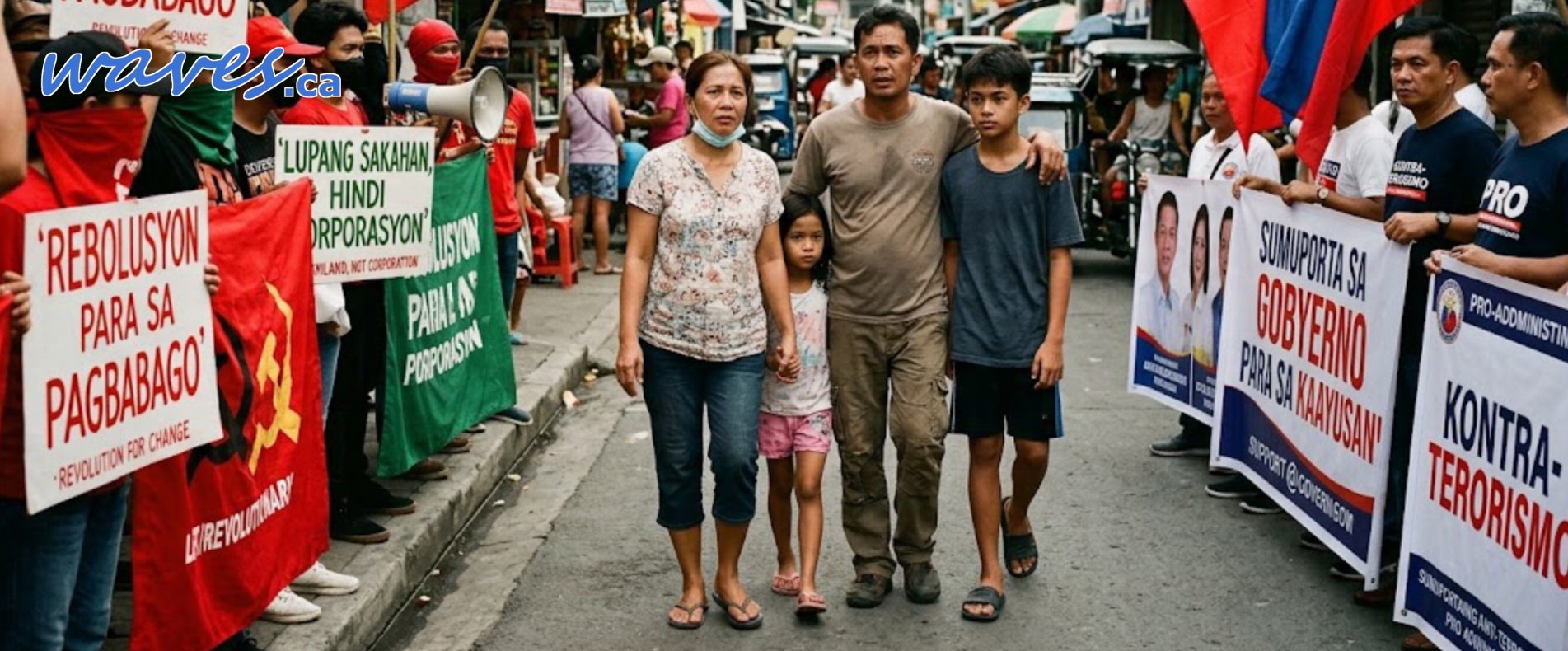
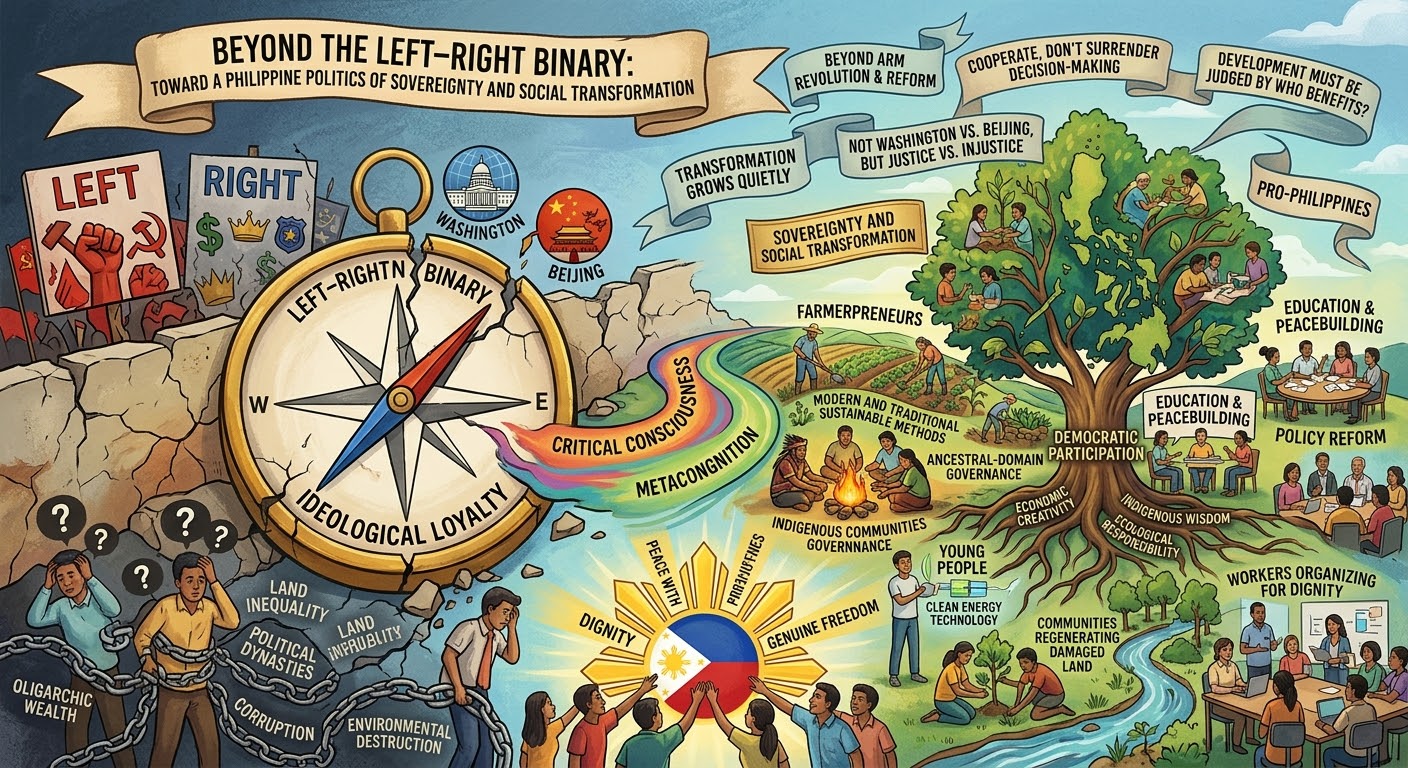
I have been reflecting on an important question in Philippine political life: What does it mean to pursue social transformation when the old ideological categories no longer adequately describe our reality? For me, the answer cannot be found simply by declaring the Philippine Left irrelevant, nor by defending everything historically associated with the revolutionary Left. Both positions are too simplistic. The deeper challenge is to distinguish between the validity of social grievances and the validity of the political strategies used to address them. The Philippines continues to experience poverty, land inequality, precarious employment, political dynasties, corruption, oligarchic concentration of wealth and power, environmental destruction, Indigenous Peoples’ struggles, and profound inequalities between urban and rural communities. These realities did not disappear simply because particular revolutionary organizations have weakened. A movement may fail in its strategy while the social conditions that produced it remain unresolved. This is why I believe we need to move beyond the question, “Is the Philippine Left still relevant?” The more important question is: “What kind of social transformation does the Philippines need today?”
From Ideological Loyalty to Critical Consciousness
At this stage of my life, I find myself less interested in defending ideological labels and more interested in examining whether an idea contributes to human dignity, justice, peace, ecological sustainability, and genuine freedom.
I do not believe that we should reject an idea simply because it comes from the Left. Neither should we accept an idea simply because it comes from the government, business community, the military, the United States, China, or any other powerful institution.
Every political project deserves critical examination.
This requires a mature political consciousness—one capable of asking difficult questions even of those with whom we generally agree.
For me, this is part of ‘metacognition applied to politics’: continuously examining our assumptions, our ideological frameworks, our emotional attachments, and our understanding of history.
Political Convergence Does Not Mean Political Alliance
One principle is particularly important in today’s geopolitical environment: Two people can arrive at the same political conclusion for completely different reasons.
Someone may oppose a particular American military agreement because of anti-imperialism. Another may oppose it because of nationalism. Another because of pacifism. Another because of environmental concerns. Another because of Indigenous Peoples’ rights.
Their positions may converge without their political identities becoming identical.
The same applies to China.
Criticizing American power does not automatically make someone pro-China. Criticizing China does not automatically make someone pro-American.
There is another possibility: being pro-Philippines.
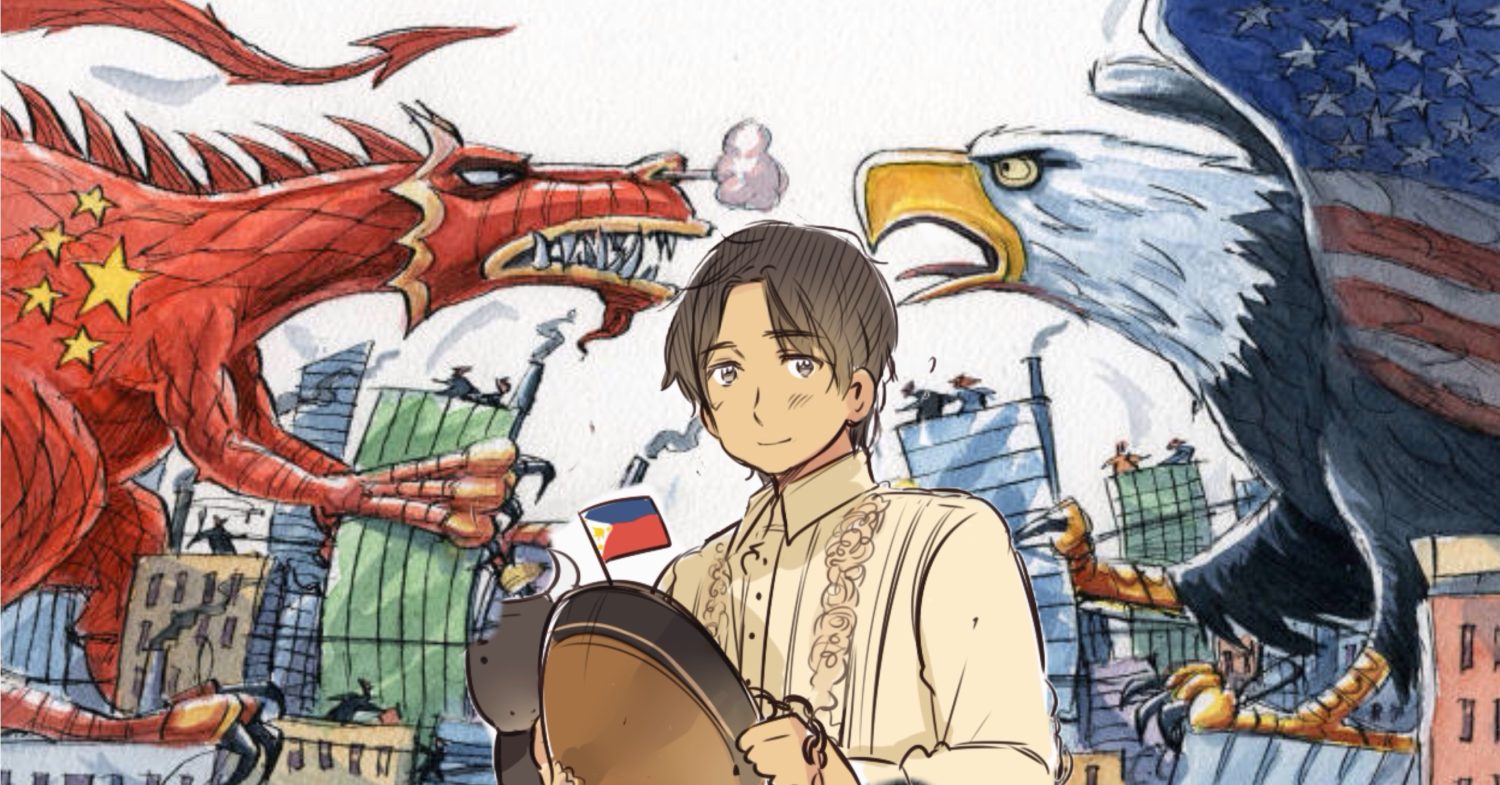
This means developing a foreign policy rooted in Philippine sovereignty and strategic autonomy rather than permanent dependence on any major power.
We can cooperate with the United States when such cooperation genuinely serves Philippine interests. We can cooperate with China when such cooperation benefits our people. We can strengthen our relationships with ASEAN, Japan, South Korea, India, Europe, and the wider Global South.
But cooperation should never require surrendering our capacity to think and decide for ourselves.
Development Must Be Judged By Who Benefits
I also believe that the debate about development needs to become more sophisticated.
Investment figures alone do not constitute development.
A technology project, industrial complex, mining operation, infrastructure program, or foreign investment package should be evaluated by deeper questions: Who owns the technology? Who controls the supply chain? Who captures the value? Who receives the jobs? Who pays the environmental costs? What technology is transferred to Filipinos? What happens to local communities? What happens to Indigenous Peoples and ancestral domains?
These are not anti-development questions. They are the fundamental questions of responsible development.
For me, genuine development means that economic growth strengthens human capabilities, local enterprises, communities, ecosystems, and national capacity rather than simply turning the Philippines into an attractive location for extracting labor, resources, data, markets, and profits.
From Revolutionary Seizure to Systemic Transformation
I am increasingly convinced that the future of social transformation does not necessarily depend upon capturing state power through armed revolution.
There are other possibilities.
Social transformation can happen through education, peacebuilding, social entrepreneurship, cooperative economics, Indigenous knowledge, ecological regeneration, democratic participation, community organizing, ethical business, policy reform, and the creation of alternative institutions.
These approaches should not be dismissed as merely reformist.
Sometimes building an alternative system is itself a form of transformation.
When farmers become farmerpreneurs, when Indigenous communities strengthen their ancestral-domain governance, when young people create social enterprises, when communities regenerate damaged land, when workers organize for dignity, and when businesses deliberately create shared prosperity, we are already changing structures.
Transformation does not always arrive as a dramatic armed revolution.
Sometimes it grows quietly, yet founded on justice, in certain communities.
The Need for a New Philippine Political Imagination
Perhaps the Philippines needs less ideological warfare and more political imagination.
We need people capable of holding several truths simultaneously:
- We can oppose exploitation without romanticizing armed revolution.
- We can criticize capitalism without rejecting entrepreneurship.
- We can defend national sovereignty without becoming isolationist.
- We can oppose American imperialism without becoming apologists for China.
- We can criticize China without becoming instruments of American geopolitical interests.
- We can support development while demanding ecological responsibility.
- We can pursue peace without ignoring injustice.
- We can defend democracy while recognizing that formal democracy is insufficient when economic and political power remain highly concentrated.
This is the political maturity I hope to see in our beloved country.
My Continuing Journey
I no longer see my task as choosing which ideological camp deserves my loyalty.
My responsibility is to keep asking:
- What contributes to justice?
- What protects human dignity?
- What strengthens communities?
- What restores our relationship with the land?
- What protects Indigenous Peoples?
- What expands genuine freedom?
- What creates peace with justice?
And ultimately: What kind of Philippines are we capable of creating together?
At this point in my journey, I believe social transformation requires something deeper than ideological victory.
It requires critical consciousness, moral courage, democratic participation, economic creativity, ecological responsibility, Indigenous wisdom, and a commitment to nonviolent systemic transformation.
Perhaps this is where we should place our energy—not in deciding whether the Left is dead or alive, but in imagining and building a Philippines where the conditions that have produced generations of injustice no longer have the power to reproduce themselves.
For me, that is the more important conversation.
Not Left versus Right. Not Washington versus Beijing. Not revolution versus reform.
But justice versus injustice, domination versus dignity, extraction versus regeneration, and violence versus peace.
And in that struggle, I choose to remain a learner, a peacebuilder, and a participant in the work of transformation.